


Mustang Vs. Airboy


iClub Silver Vendor
iTrader: (25)
Joined: Nov 2002
Posts: 15,494
From: Participating in some Anarchy!
Car Info: 2005 LGT wagon
First, let's define "horsepower":
As you can see, one must know two of the three variables in order to calculate the third.
The mustang dyno physically measures the torque applied by the drive wheels and calculates horsepower.
Inertia dynos...dynojet....use a fixed mass(roller), measures the power required to accelerate said mass, and calculates torque.
Computer-based "dynos" physically measure nothing, except maybe g-loads if the computer has the ability.
The software uses various constants that the user supplies, records certain vehicle/engine data streams, and calculates torque and horsepower.
As Ben has shown, there can be some difference in what each type of dyno reports to us.
Which brings up the difference between being "accurate" and precise".
Ideally, any measuring tool should be both precise and accurate.
Think of a 1" rod. You use a dial caliper to take three measurements, getting 1.001", 1.000", and .999".
This is pretty accurate, but not very precise, as the delta between the lowest and highest values is .002"
Now, use micrometer that reads to .0001". You get three measurements 0f .8999", .8999", and .8999". The micrometer is much more precise,but in this made up example, the accuracy sucks.
What does this have to do wth chassis vs PC dyno plots?
Which dyno reports the most accurat AND precise values?
Depends on your beliefs, I guess.
As long as I know that certain parts installed on a certain type of car gives me a certain expected increase, I'm happy.
BTW. the above quotes are not my own.
1 HP ≡ 33,000 ft·lbf/min by definition
= 550 ft·lbf/s since 1 min = 60 s
= 550×0.3048×0.45359237 m·kgf/s since 1 ft = 0.3048 m and
= 76.0402249068 kgf·m/s 1 lb = 0.45359237 kg
= 76.0402249068×9.80665 kg·m2/s3 g = 9.80665 m/s2
= 745.69987158227022 W since 1 W ≡ 1 J/s = 1 N·m/s = 1 (kg·m/s2)·(m/s)
Or given that 1 hp = 550 ft·lbf/s, 1 ft = 0.3048 m, 1 lbf ≈ 4.448 N, 1 J = 1 N·m, 1 W = 1 J/s: 1 hp = 746 W
= 550 ft·lbf/s since 1 min = 60 s
= 550×0.3048×0.45359237 m·kgf/s since 1 ft = 0.3048 m and
= 76.0402249068 kgf·m/s 1 lb = 0.45359237 kg
= 76.0402249068×9.80665 kg·m2/s3 g = 9.80665 m/s2
= 745.69987158227022 W since 1 W ≡ 1 J/s = 1 N·m/s = 1 (kg·m/s2)·(m/s)
Or given that 1 hp = 550 ft·lbf/s, 1 ft = 0.3048 m, 1 lbf ≈ 4.448 N, 1 J = 1 N·m, 1 W = 1 J/s: 1 hp = 746 W
Relationship with torque
For a given torque and speed, the power may be calculated. The standard equation relating torque in foot-pounds, rotational speed in RPM and horsepower is:

Where P is power, Τ is torque, and ω is rotations per minute. The constant 5252 comes from (33,000 ft·lbf/min)/(2π rad./rev.).
For a given torque and speed, the power may be calculated. The standard equation relating torque in foot-pounds, rotational speed in RPM and horsepower is:
Where P is power, Τ is torque, and ω is rotations per minute. The constant 5252 comes from (33,000 ft·lbf/min)/(2π rad./rev.).
The mustang dyno physically measures the torque applied by the drive wheels and calculates horsepower.
Inertia dynos...dynojet....use a fixed mass(roller), measures the power required to accelerate said mass, and calculates torque.
Computer-based "dynos" physically measure nothing, except maybe g-loads if the computer has the ability.
The software uses various constants that the user supplies, records certain vehicle/engine data streams, and calculates torque and horsepower.
As Ben has shown, there can be some difference in what each type of dyno reports to us.
Which brings up the difference between being "accurate" and precise".
Ideally, any measuring tool should be both precise and accurate.
Think of a 1" rod. You use a dial caliper to take three measurements, getting 1.001", 1.000", and .999".
This is pretty accurate, but not very precise, as the delta between the lowest and highest values is .002"
Now, use micrometer that reads to .0001". You get three measurements 0f .8999", .8999", and .8999". The micrometer is much more precise,but in this made up example, the accuracy sucks.
What does this have to do wth chassis vs PC dyno plots?
Which dyno reports the most accurat AND precise values?
Depends on your beliefs, I guess.
As long as I know that certain parts installed on a certain type of car gives me a certain expected increase, I'm happy.
BTW. the above quotes are not my own.
Last edited by FW Motorsports; Mar 30, 2010 at 10:32 AM.

Thread Starter
Registered User
iTrader: (1)
Joined: Feb 2010
Posts: 378
From: Elk Grove, CA
Car Info: 7 Series "Sport"
Ahh! I love the proper use of accuracy and precision!!
Unfortunately, in this case, accuracy is just open to huge amounts of debate..
What kind of power translates into what kind of track results on what kind of cars with engines that produce what kinds of HP at the crank with what kinds of drivetrain losses.. ETC ETC ETC ETC ETC.....
In the end, YAH, who cares.. Part X or tune Y produced THESE repeatable results.. Mission accomplished..
Thats why I don't get hung up on #'s..
But in my personal opinion, due to the methods that a Mustang uses to measure force, properly maintained, and properly calibrated, a mustang is a superior machine.
Unfortunately, in this case, accuracy is just open to huge amounts of debate..
What kind of power translates into what kind of track results on what kind of cars with engines that produce what kinds of HP at the crank with what kinds of drivetrain losses.. ETC ETC ETC ETC ETC.....
In the end, YAH, who cares.. Part X or tune Y produced THESE repeatable results.. Mission accomplished..
Thats why I don't get hung up on #'s..
But in my personal opinion, due to the methods that a Mustang uses to measure force, properly maintained, and properly calibrated, a mustang is a superior machine.
Thread Starter
Registered User
iTrader: (1)
Joined: Feb 2010
Posts: 378
From: Elk Grove, CA
Car Info: 7 Series "Sport"
You could also make the argument that the inertia type dynos are a much simpler machine and therefore more precise, but that depends on your criteria for precision..
There is a "fudge factor" in an inertia dyno.. The inertia part.. If you have small problems with your tune, the intertia built up in the rollers can mask it some.. Same way a heavier flywheel smooths out power delivery..
Looking back at my mustang logs, any spot where you can see dips in the torque you can go back to the log and track down the exact event that may have caused it.. Dips in airflow, small variances in AFR's, etc..
My opinion is that you get a much better resolution of what exactly is going on when you are dealing with a brake dyno vs an inertia dyno..
There is a "fudge factor" in an inertia dyno.. The inertia part.. If you have small problems with your tune, the intertia built up in the rollers can mask it some.. Same way a heavier flywheel smooths out power delivery..
Looking back at my mustang logs, any spot where you can see dips in the torque you can go back to the log and track down the exact event that may have caused it.. Dips in airflow, small variances in AFR's, etc..
My opinion is that you get a much better resolution of what exactly is going on when you are dealing with a brake dyno vs an inertia dyno..




iClub Silver Vendor
iTrader: (12)
Joined: Mar 2003
Posts: 8,228
From: 631 Railroad Ave. Fairfield, CA
Car Info: A Laptop
Inertia dynos like the dynojet don't measure power directly either. All they measure is roller speed, and using a set of defined constants, they calculate power and torque at the wheels just like the mustang. The only major difference is that the Mustang and any load bearing dynos have an extra variable to account for because they are applying a variable load to the rollers.
Computer-based "dynos" physically measure nothing, except maybe g-loads if the computer has the ability.
The software uses various constants that the user supplies, records certain vehicle/engine data streams, and calculates torque and horsepower.
The software uses various constants that the user supplies, records certain vehicle/engine data streams, and calculates torque and horsepower.
Its important to remember that these defined constants can always be changed by the end user to make any road dyno or chassis dyno software read just about anything you'd like. Its always up to the end user/operator to make sure the constants being used are accurate and appropriate.
As Ben has shown, there can be some difference in what each type of dyno reports to us.
Which brings up the difference between being "accurate" and precise".
Ideally, any measuring tool should be both precise and accurate.
Think of a 1" rod. You use a dial caliper to take three measurements, getting 1.001", 1.000", and .999".
This is pretty accurate, but not very precise, as the delta between the lowest and highest values is .002"
Now, use micrometer that reads to .0001". You get three measurements 0f .8999", .8999", and .8999". The micrometer is much more precise,but in this made up example, the accuracy sucks.
What does this have to do wth chassis vs PC dyno plots?
Which dyno reports the most accurat AND precise values?
Depends on your beliefs, I guess.
As long as I know that certain parts installed on a certain type of car gives me a certain expected increase, I'm happy.
BTW. the above quotes are not my own.
Which brings up the difference between being "accurate" and precise".
Ideally, any measuring tool should be both precise and accurate.
Think of a 1" rod. You use a dial caliper to take three measurements, getting 1.001", 1.000", and .999".
This is pretty accurate, but not very precise, as the delta between the lowest and highest values is .002"
Now, use micrometer that reads to .0001". You get three measurements 0f .8999", .8999", and .8999". The micrometer is much more precise,but in this made up example, the accuracy sucks.
What does this have to do wth chassis vs PC dyno plots?
Which dyno reports the most accurat AND precise values?
Depends on your beliefs, I guess.
As long as I know that certain parts installed on a certain type of car gives me a certain expected increase, I'm happy.
BTW. the above quotes are not my own.
 .
.Precision is the ability to get consistent back to back measurements. I'll also agree that most chassis dynos will provide a more repeatable measurement than most road dyno software. This is not because of the actual measuring equipment, but rather it has mainly to do with the fact that chassis dynos are usually in a more consistent controlled environment than is possible for road dyno pulls. If you assumed perfect conditions for a road dyno pull, using the exact same, perfectly flat stretch of road, with no wind, constant temperature, etc, then the precision would be exactly that of a good chassis dyno setup. This of course goes for chassis dynos as well. If the conditions in the room change significantly, "precision" goes out the window.
Accuracy is a tough one when it comes to dynos because most of them tend to read differently. Who is to say which numbers are more "accurate" than others? IMO, a road dyno pull under ideal conditions as described above, will actually give you the most accurate number. This is because its measuring/calculating the car's actual on-road performance under real world conditions and using basic, proven physics concepts for its calculations.
At the end of the day, accuracy really doesn't matter nearly as much as precision when it comes to tuning. Any good tuner is always mainly looking at the delta rather than the absolute numbers. Of course accurate readings would still be nice and would enable us to compare car to car from different dynos. It seems like we're a long way away from that, however.
I also want to clear something up. I know it may seem that I don't like chassis dynos or am against them in some way, but that's not the case at all. Our own chassis dyno is on order and expected to arrive the 3rd week of April
. I believe a chassis dyno can be a valuable tool in the right hands, and a huge convenience factor overall. I don't, however, believe that a chassis dyno is the ONLY way to tune a car properly. Good road dyno software can be a very valuable tool as well when making adjustments on the road or track. I also believe that any tune done on a chassis dyno absolutely must be verified and adjusted on a real road under real conditions after the dyno work. This is a critical step to making sure that a tune or component works as expected where the car is actually driven. This is impossible to do without at least some testing on the road or track.Thanks
-- Ed
Last edited by EQ Tuning; Mar 30, 2010 at 05:48 PM.
iClub Silver Vendor
iTrader: (25)
Joined: Nov 2002
Posts: 15,494
From: Participating in some Anarchy!
Car Info: 2005 LGT wagon
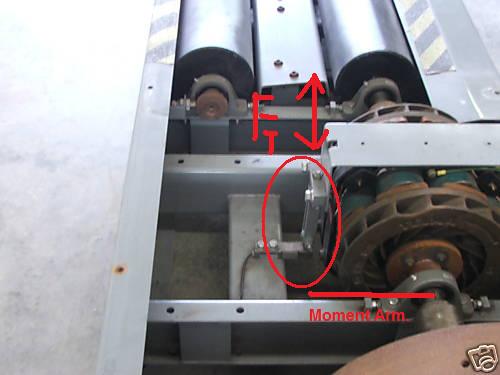
Only picture I could find of a PAU.
The circled device is a strain gauge...it measures push/pull force of the PAU.
Force X Distance(Moment arm) = Torque.
iClub Silver Vendor
iTrader: (12)
Joined: Mar 2003
Posts: 8,228
From: 631 Railroad Ave. Fairfield, CA
Car Info: A Laptop
What I'm trying to show is that even a chassis dyno does not physically or directly measure power or torque. There are always significant calculations to be done using defined variables to derive the wheel power and torque that we're all used to seeing. The point of all this is to show that this is exactly how road dyno software works as well. The ONLY major difference is in how the various dyno systems acquire their data.
Thanks
-- Ed
iClub Silver Vendor
iTrader: (12)
Joined: Mar 2003
Posts: 8,228
From: 631 Railroad Ave. Fairfield, CA
Car Info: A Laptop
You could also make the argument that the inertia type dynos are a much simpler machine and therefore more precise, but that depends on your criteria for precision..
There is a "fudge factor" in an inertia dyno.. The inertia part.. If you have small problems with your tune, the intertia built up in the rollers can mask it some.. Same way a heavier flywheel smooths out power delivery..
My opinion is that you get a much better resolution of what exactly is going on when you are dealing with a brake dyno vs an inertia dyno..
There is a "fudge factor" in an inertia dyno.. The inertia part.. If you have small problems with your tune, the intertia built up in the rollers can mask it some.. Same way a heavier flywheel smooths out power delivery..
My opinion is that you get a much better resolution of what exactly is going on when you are dealing with a brake dyno vs an inertia dyno..
I think the main benefit to a brake dyno is the capability to replicate a real world load curve and to provide steady state testing which is impossible on an inertia dyno. This certainly makes the brake dyno a more useful tuning and R&D tool all around, but I don't think there's necessarily an advantage in terms of actual resolution of the power measurements.
BTW, Dynojet also makes a brake dyno and Mustang also makes a large roller dyno
.Thanks
-- Ed
iClub Silver Vendor
iTrader: (25)
Joined: Nov 2002
Posts: 15,494
From: Participating in some Anarchy!
Car Info: 2005 LGT wagon
I'm not sure exactly what data road dyno software uses to derive torque/hp, but I've seen timing, MAF, rpm inputs used.
None of these data variables are used in calculating torque or horsepower.
The strain gauge on a dyno measures how much force is applied to the PAU, and with a known moment length, torque is calculated.
Maybe you can explain exactly what data stream(s) variables your road dyno software uses to derive torque and thus hp?
None of these data variables are used in calculating torque or horsepower.
The strain gauge on a dyno measures how much force is applied to the PAU, and with a known moment length, torque is calculated.
Maybe you can explain exactly what data stream(s) variables your road dyno software uses to derive torque and thus hp?
iClub Silver Vendor
iTrader: (12)
Joined: Mar 2003
Posts: 8,228
From: 631 Railroad Ave. Fairfield, CA
Car Info: A Laptop
I'm not sure exactly what data road dyno software uses to derive torque/hp, but I've seen timing, MAF, rpm inputs used.
None of these data variables are used in calculating torque or horsepower.
The strain gauge on a dyno measures how much force is applied to the PAU, and with a known moment length, torque is calculated.
Maybe you can explain exactly what data stream(s) variables your road dyno software uses to derive torque and thus hp?
None of these data variables are used in calculating torque or horsepower.
The strain gauge on a dyno measures how much force is applied to the PAU, and with a known moment length, torque is calculated.
Maybe you can explain exactly what data stream(s) variables your road dyno software uses to derive torque and thus hp?
The key here is that the RPM data over time can be used to calculate acceleration. Other road dyno software also measure acceleration using other methods such as accelerometers or speed sensors. But no matter how you acquire the data, once you have an acceleration curve and the necessary defined constants, its very easy to derive whp/wtq (I'll spare you guys the equations). This is also very similar to how a dynojet works as the only real data it acquires is roller RPM over time.
Thanks
-- Ed

plays well with others
iTrader: (1)
Joined: Aug 2006
Posts: 9,923
From: Sac
Car Info: your mother crazy
Originally Posted by EQ Tuning
My particular software uses RPM data along with a time reference as its primary input. You can think of this as acceleration. Then using this data and a set of defined constants, the software calculates the force necessary to achieve the measured acceleration and derives whp/wtq.
The key here is that the RPM data over time can be used to calculate acceleration.
The key here is that the RPM data over time can be used to calculate acceleration.
This is still a bit misleading. The Mustang dyno doesn't physically measure torque either. The load cell measures the force applied to the rollers and the software logs this force along with roller speed, and the force exerted by the eddy brake to impose the desired RPM. Then using this data and a set of defined constants (roller diameter, roller mass, gearing, etc), it calculates torque and power at the drive wheels.
t=r*F and since the magnitude (r) of the roller is a constant, the mustang is measuring force, both wheel and roller are round bodies so force angle at the deflection point wont figure in either. yes while you still have to solve for t but its 3rd grade level multiplication.
when you use your software to dyno are you accounting for all three forms of parasitic drag that act on a car (though wave drag is probably negligible)? What polling interval do you use for airspeed of the vehicle to ensure that drag data is correct for the duration of the pull?? How do you account for small changes in road surface effecting the data? spring compression/expansion causes the vehicle cross-section (and thus drag coefficient) to change dynamically.
granted, i never finished my degree in aerospace engineering... but to me this seems about as simple as calculating torque with a drag chute, digital spring scale, and a my tow hook... the potential fudge factor here is huge.
we could set up a sample... take 20 i-clubbers with various mods and their mustang dyno sheets and go to the drag strip on a comparable day in terms of temp and humidity for each of their respective tunes/pulls.
plotting the dyno data vs track times/speeds in excel, then i could enter the trap time/speeds of other cars and guestimate their wtq/whp to within about 6% of their real dyno numbers (i'm a bit rusty, so i rounded up). the margin of error would be 0 on a perfectly flat drag strip, in a vacuum. it would work just as well as a real dyno once enough reference data was added.
this is a clearly ridiculous in premise but still would yield some acurate-ish results even outside of a perfect test environment.

iClub Silver Vendor
iTrader: (12)
Joined: Mar 2003
Posts: 8,228
From: 631 Railroad Ave. Fairfield, CA
Car Info: A Laptop
the problem i have with this statement is that the sampling is not performed under conditions where there is equilibrium (no pun intended). Vehicle is moving through a fluid so we are no longer doing simple f=ma. you said it yourself, under perfect conditions (perfectly flat road, no wind, etc) it would be close but this still ignores the fact that your "perfect conditions" would really be a road dyno test, on a flat road, in a vaccuum.... which is impossible, at least on this planet seeing as it's an elipse.
this is also a bit misleading.
t=r*F and since the magnitude (r) of the roller is a constant, the mustang is measuring force, both wheel and roller are round bodies so force angle at the deflection point wont figure in either. yes while you still have to solve for t but its 3rd grade level multiplication.
t=r*F and since the magnitude (r) of the roller is a constant, the mustang is measuring force, both wheel and roller are round bodies so force angle at the deflection point wont figure in either. yes while you still have to solve for t but its 3rd grade level multiplication.
when you use your software to dyno are you accounting for all three forms of parasitic drag that act on a car (though wave drag is probably negligible)? What polling interval do you use for airspeed of the vehicle to ensure that drag data is correct for the duration of the pull?? How do you account for small changes in road surface effecting the data? spring compression/expansion causes the vehicle cross-section (and thus drag coefficient) to change dynamically.
. The air speed is assumed from the ground speed, so the polling interval is exactly that of the general data stream rate and the calculated road speed is interpolated between data points. Of course all of this is just an approximation of the major forces at play. It would be nearly impossible to account for all variables such as wind, small changes in the road surface, dynamic motion from suspension, slight variations in air density, tire deflection, etc, etc. To the same degree, a chassis dyno suffers from similar limitations. It cannot account for variable tire deflection on the rollers, unbalanced tires, poor alignments, inconsistent strapping force, etc, etc. I've seen variations of up to 10-15whp depending on how hard the car was strapped down to a chassis dyno.
The important thing with either system is to try to keep things consistent, to minimize the deltas from external factors. You will never be able to account for every single variable, but accounting for the major ones and keeping the more minor ones in check allows us to still get good, consistent, repeatable data that we can use for back to back comparison.
we could set up a sample... take 20 i-clubbers with various mods and their mustang dyno sheets and go to the drag strip on a comparable day in terms of temp and humidity for each of their respective tunes/pulls.
plotting the dyno data vs track times/speeds in excel, then i could enter the trap time/speeds of other cars and guestimate their wtq/whp to within about 6% of their real dyno numbers (i'm a bit rusty, so i rounded up). the margin of error would be 0 on a perfectly flat drag strip, in a vacuum. it would work just as well as a real dyno once enough reference data was added.
this is a clearly ridiculous in premise but still would yield some acurate-ish results even outside of a perfect test environment.
plotting the dyno data vs track times/speeds in excel, then i could enter the trap time/speeds of other cars and guestimate their wtq/whp to within about 6% of their real dyno numbers (i'm a bit rusty, so i rounded up). the margin of error would be 0 on a perfectly flat drag strip, in a vacuum. it would work just as well as a real dyno once enough reference data was added.
this is a clearly ridiculous in premise but still would yield some acurate-ish results even outside of a perfect test environment.
). The main problem is that you are leaving huge variables in terms driver ability, tires/suspension setup, vehicle weight, etc. But with enough data points you could probably still get some sort of idea of the general trend.-- Ed
iClub Silver Vendor
iTrader: (12)
Joined: Mar 2003
Posts: 8,228
From: 631 Railroad Ave. Fairfield, CA
Car Info: A Laptop
 ! SCUBA tanks?
Luckily it doesn't need to be in a vacuum
.
And I love equations, especially the types I don't know.
BTW, I'm very impressed how well we have been able to carry on this technical discussion without things getting too nasty. I always enjoy some good nerd talk
.-- Ed
Last edited by EQ Tuning; Mar 31, 2010 at 07:37 PM.